Sep 102011
 

Welcome to Fashioning Circuits, a scholarly archive of materials related to Fashion and Emerging Media.

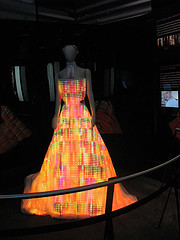
Photo “electronic led light dress at the museum of science and industry in chicago” by Flickr user David Hilowitz

Fashioning Circuits was launched in September 2011 as part of a series of independent studies in the graduate program in Emerging Media and Communication (EMAC) at the University of Texas, Dallas. The goal of the project is to explore the ways in which fashion and emerging media intersect. Areas of intersection might include the ways in which fashion and emerging media are constantly in flux, looking forward; the fashions of emerging media, including social media and hardware; expressions of identity; wearable media; smart textiles, vernacular expression; network theories; global labor issues; gender representation, sexuality, race, class and embodiment; etc.

As the site develops, you can expect to see posts in the following categories:

  • History – historical impact of science, technology, and media on fashion.
  • Wearables – examples of wearable media, smart textiles, etc.
  • Annotated Bibliography – annotated entries describing and analyzing books, articles, film, etc.
  • Emerging Media – examples and analysis of blogs, social media, etc. as they pertain to fashion.
  • Representations – representations of fashion in media, including art, media, games, social avatars, etc.
  • Identity – analysis of the impact of fashion and emerging media on identity, including raced, classed, gendered and sexualized bodies.

This is only our best guess at topic areas given the preliminary stages of the project. Our intention is to allow the categories to develop organically as we follow the paths on which our research takes us. So please stay tuned as the project develops. If you have suggestions, we would love to hear from you.

Aside from the blog archive, the editorial team is also active on Twitter. Search for the hashtag #fashioningcircuits to see all of the interesting resources we are finding and sharing.

If you are at UT Dallas and would like to join us for creative workshops, the remaining dates in the Spring 2013 semester are below. All meetings are in the ATEC 1.504 (Mobile Lab).

  • February 26 5pm – 6:30pm
  • March 19 5pm – 6:30pm
  • April 2 5pm – 6:30pm
  • April 16 5pm – 6:30pm
  • April 30 5pm – 6:30pm


May 142013
 

This semester in Fashioning Circuits, I was commissioned (re: required) to create a final project that exhibited the dual nature of fashion and circuits. Although I felt up to the challenge, I actually spent many weeks accidentally setting my project on fire and haphazardly learning about coding. It wasn’t all bad: I gained some new programming and sewing experience, learned a lot more about fashion and its intersections with sociology and my personal experiences, and also learned that I am capable of coming up with really cool ideas, even if they don’t exactly see the finish line.

The premise of my project was simple: visibility. I wanted to use fashion to positively steer my personal representation in public; thus, the idea of a pair of light-up “twerking” short really appealed to me. I intended (and still intend!) to wear such shorts in a party environment  where dancing was encouraged. The idea was to have the shorts light-up according to my movement: it would draw a lot of attention to me, but it would be on my terms (when dancing) and according to my comfort level. In part, the shorts would be a commentary on eating disorders and body image, being a Black woman in primarily Othering or hostile spaces, and empowerment via active and visible struggles against anti-Black misogyny.

My plan was to use an accelerometer that would take in my movement and generate it into a current that would affect a LED light, so that the light would flicker faster or slower. Having several LEDs positioned throughout the skirt would create a fashionable aesthetic that would still adhere to the “stylistic” part of the project. The circuitry would be moved by the Lilypad Arduino, a microcontroller board designed for wearables such as my project, and would serve as the brain of the operation.

Unfortunately, I ran into a couple of complications, the main one being that my Arduino seemed to be damaged. While trying to connect the circuity to my skirt using conductive tread, my Arudino would constantly lose charge, catch on fire or stop responding to my laptop. In the beginning I was able to successfully program the Arduino, but overtime–and with many re-sewings, my Arduino began to suffer many scratches and eventually began to spark and catch on fire when the current was turned on.

Another issue I had was successfully sewing the circuit together. Conductive thread requires that the wires do not touch, and I had to sketch out several placements in order to reach the right one. At one point, I’d have faulty wiring but was able to build a circuit; at another point, I had the complete opposite. Sketching helped some times, but was not able to award me with a complete circuit all of the time. My amateur relationship with conductive thread and programming also played a part in how well I was able to conduct things semester.

Despite some shortcomings, I feel that I have definitely learned a lot this year. Programming has never been my strong suit (I’m a coding kind of girl!), but learning about the Arduino software and its related code has helped me very much expand my ideas about coding. My sewing has gotten a little better too, as well as my technical knowledge and history of fashion.

In the end, I would very much like to continue the product. I do believe my intentions are still important and would love to see the project come into fruition. I know this will definitely require better knowledge of programming and the Arduino, but I am very much excited to pick up the task.

May 112013
 

In honors in Mother’s Day, I’ve been thinking a lot about my mother’s fashion. I grew up as a 90s kid surrounded by the neon flash and bold prints of clothes only children could wear; my mom, in comparison, wore very subdued, neutral clothing. Her style still remains very much the same today: a splash of color here, a higher heel there–but very much separated from other mothers. As a child, I (understandably) couldn’t comprehend why my mother didn’t look like other mothers, like the ones who picked up my friends from day care wearing brands I couldn’t pronounce. With time, I came to understand the larger factors surrounding my mother’s life that prevented her from wearing the “flossy flossy”: money was always tight, hours were long and trends eluded her. As a long time immigrant,  my mother never really paid attention to the newest and the brightest. She tolerated my (short lived) love for trends with the patient suffering of any mother, but chose  along to her personal tastes when she shopped for herself, which was once a year. Most of her clothes were functional: able to last for months on end, not susceptible to rips or tears, overwhelmingly cheap (so she could get multiples if needed) and able to allow her movement (for running after children, cooking, and cleaning.)

Functionality is a huge part of “mommy fashion,” which seems to be a growing trend for “every day moms” everywhere. I realize now that my mother was not only thinking with her wallet, she was thinking with her “motherly instincts.” What allows mothers to move, work, perform to the best of her abilities and look “fly?” Mommy fashion, at its core, takes in all of these factors; it not only asks whether functionality can work, it requires it.

Continue reading »

Mar 192013
 

Hip-hop and streetwear have always been about access on some level. False scarcity drives up second-hand prices and increases one’s credibility for owning and flaunting notably rare items of clothing. Acquisition of these goods requires knowing when and where to go, and having the means with which to purchase them.

As both industry and press for streetwear have moved progressively more online, it’s been fascinating to see how ideas of exclusivity and access have changed, and the ways in which they’ve stayed the same. Brands have been known to attempt a balancing act within which they maintain a certain amount of presence and have a certain amount of regard, but also remain obscure enough to be valued for both infrequency and credibility. With the internet, it becomes absurd to think that there are things one is unable to purchases so long as the money is there. We are so used to a culture online that promises to deliver to us nearly anything we want — with 2-day shipping no less. How can brands adapt to these norms?

Continue reading »

 Posted by at 11:58 pm
Mar 192013
 

If ever there were a precarious moment when the foundations of the great houses of fashion should tremble this is it.  Labels rely on three elements when crafting fashion, and one is about to become obsolete.  Aesthetic, innovation, and scarcity rule the industry.  Designers are skilled artists working within the medium of silhouette and texture.  Their clothes tease out elements of rich subcultures, offering visual satire of our most sacred assumptions: gender, religion, desire.

“Ghastly!” we hiss.  Then a little softer “does it come in black?”

Subdivision Cuff by NervousSystem $55 via Shapeways

Subdivision Cuff by NervousSystem $55 via Shapeways

Twenty-first century innovation has spawned revolutionary thought in manufacturing textiles.  New technologies like AirDye utilize heat to transfer dye from paper to textiles, saving as much as 75 gallons of water per pound of fabric.  Conventional dying, which many industry leaders outsorce to developing countries, produces up to 72 different chemicals, 30 of which do not break down and can cause significant groundwater issues.  Inde label I Am Not A Virgin pairs unprocessed “virgin” cotton with synthetic fibers from reclaimed plastic bottles and lunch trays to make their jeans.

Having breifly established the relative continuity of aesthetic evolution and innovation, the lights turn to scarcity.  After all, haute couture, basically boils down to a exclusive creation only available to the select few with the connections and the money to obtain it.  I can name other industries that rely on scarcity to drive up prices, but the comparison most suitable is the music industry.  That’s right, Alexander McQueen, prepare to meet your Napster.


The future of 3-d printing means anyone with access to 3-d software and a printer will be able to recreate haute couture’s wearable sculptures.  They’ll be cheap(er), easy to modify, and perfectly specified to the wearer’s form.  And for many designers, they’ll also be the end of outsorcing labor under deplorable conditions.

I’m saving an in-depth look at intellectual property where the fashion industry is concerned for another post: however, I do want to highlight a very important change that 3-d printing is bringing about.  Even if budding designers don’t have access to 3-d printers, which are still relatively expensive, the technology is becoming more accessible every day.  For example, Shapeways allows users to create or upload a design and they’ll send you the finished product.  Similar to Etsy, Shapeways’ users are encouraged to set up stores and sell their products directly on the site.  Shapeways means that anyone can break into the fashion industry regardless of their textile pedigree.  And with the new crowd come engineers, gamers, and hacktivists.  Tremble, Fifth Avenue.

Zenith Crown by unellenu utelizes fractals in design (via Shapeways)

Zenith Crown by unellenu via Shapeways


Mar 192013
 

With the evolution of 3-d printing, functional fashion is due a radical awakening.  I’m not talking about structural creations with which some of the well established fashion houses have begun to experiment.  Within the next decade we should see the capability to print human tissue using a patient’s own stem cells, and eventually biomedical engineers will be able to grow replacement organs and limbs.  For now, 3-d printing is finding a niche in artistic prosthetics.


When Bespoke Innovations started to gain momentum in 2010, industrial designer and co-founder Scott Summit drew on fashion trends, and design elements from luxury and sports cars, as well as motorcycles when assisting clients in designing their fairings for prosthetic limbs.  A fairing goes over or attaches to an existing prosthesis in order to help regain limb symmetry.  Once the desired dimensions are established using 3-d scanning and software, Bespoke Innovations uses 3-d printers to create each custom-made fairing.

bespoke_sarah_4108web

chad skateboard 2

Bespoke Chrome


While Bespoke Innovations can turn an existing prosthesis into a functional sculpture, veteran and architectural designer Collin MacDuff is just one of a number of people who were so dissatisfied with the lack of function in available prosthetics that he began tinkering on his own.  MacDuff drew on 15 years of fabrication and welding experience to create his Biomechanical Prosthetic Finger (BFP), which mimics the natural flexion of the finger so that the prosthesis moves exactly the same way an existing digit does.  One glance and industrial chic comes to mind, which is particularly fitting since MacDuff crafted the prototype from a bicycle handlebar.

For now the BPF is manually assembled but it represents a shift in self-agency when it comes thinking about prosthetics.  Amputees need not rely on others when it comes to their own body aesthetic.  All they need is access to 3-d scanning and modeling software, and a 3-d printer.  Want to wear a brushed silver calve to your aunt’s Titanic themed wedding?  No problem.  How about a lighted pedicure to help you find your way to the front door without sloshing your new strappy sandals through any puddles?  A little more tricky, but entirely manageable for about $50 with micro LEDs and an Arduino LilyPad from SparkFun.

In addition to pioneering biomechanics and fashion, the two aforementioned designers have also tapped into the empowering aspects of amputee subculture.  Amputations are the result of frostbite from enduring the elements, competition in extreme sports, valorous combat far from loved ones, and long battles with significant illness.  Even if an amputation is planned and brings some element of relief, it still requires the individual to graduate physical therapy and adjust to a new absence of the symmetry they’ve relied on their entire lives.  Now, finally, we’re beginning to see individuality and innovation combined with form and function that opens an entirely new world—not just for amputees—but for everyone else who’ll soon have a window allowing us to visually connect prosthetics with the active and artistic trends of their users.

model


Jan 082013
 

I am pleased to be able to return to work on Fashioning Circuits in Spring 2013, with a group of five new students!

Changes to this semester include:

  • Undergraduate students working on the project for the first time.
  • Weekly meetings will alternate between reading/discussion and open studio time.
  • Periodic blogging due dates to ensure blog posts throughout the semester.
  • Two wearable projects
    • one early in the semester to facilitate comfort / familiarity with materials and equipment
    • a deeper, more theoretically informed project due at the end of the semester

We will once again begin with Rebecca Arnold’s Fashion: A Very Short Introduction. After that, possible readings include:

as well as readings from previous semesters and various blogs, apps, and social media sites.

I also look forward to continuing our work with the LilyPad arduino and to trying out the Adafruit Flora. Follow our progress here and on Twitter.

May 122012
 

The Superman "S" Logo. Image credit: Wikipedia.com

The concept of the cyborg or techno-fashion is not a new one to Fashioning Circuits. Fashion that has the ability to extend the capabilities of the human body is a topic that I, for one, find particularly fascinating. It may surprise the FC reader, howeve,r to learn that there also exists another perhaps lower tech but no less integral component to techno-fashion, that is fashion that can compensate for physical deficiencies. Recent developments in the nascent techno-fashion industry have seen the proliferation of brands producing garments to not only enhance the human body but indeed to improve the quality of life for individuals afflicted with various physical deficiencies and impairments. Let’s take a look at some particularly inspiring innovators in this techno-fashion space.

The GPS Shoe for Tracking Alzheimers Patients

GPS Shoe

In 2011 US based GTX Corp introduced the GPS shoe, a walking shoe with a miniature GPS tracking device embedded in the heel. The inspiration for the shoe was originally spurred by a particularly tragic and high profile missing persons case in involving  the disappearance of a young child. In fact GTX CEO Patrick Bertagna originally created the shoe as a means of tracking missing children.  It wasn’t long, however, before Bertagna became aware of  an even greater need for the shoe among adult caregivers of Alheimer’s sufferers to be able to non intrusively track the movements of their patients.

GPS tracking devices for Alzheimers’s patients were not in and of themselves a new idea, even in 2011. However, prior to the GPS Shoe it was not uncommon for  Alzheimer’s sufferers to reject the devices out of fear or confusion.  The GPS Shoe provides the caregiver with a means to monitor their charges via smartphone or computer with an interactive map. The caregiver can even establish “safe zones” whereby they will be immediately notified with a text message if the patient wanders outside of a pre-established geographical perimeter.

The GPS Shoe does present some real privacy concerns as the design of the device is deliberately intended to be undetectable by the wearer. I do wonder at the potential ease of abuse of the shoe by those who seek to monitor non Alheimer’s sufferers for purely selfish and possibly dangerous reasons. However, the safety of Alzheimers sufferers as well as the peace of mind afforded their caregivers just may outweigh its’ potential threats to privacy.

Hickies: Elastic Shoelaces for Arthritis Sufferers

Hickies

Hickies are an elastic shoelace replacement system that completely eliminate the need for tying shoelaces. The rubber devices feature a hook and loop fastening system intended to be fed through the eyelets of laced shoes in place of traditional shoelaces, one device per row of eyelets. Hickies, which come in one size and a rainbow of colors, are designed to replace traditional shoelaces in any type of shoe or boot. Aesthetically, Hickies can be used to customize any heretofore laceable footwear and also allow for the slipping on and off of shoes without the need to tie and untie shoelaces.

Though not developed specifically with arthritis sufferers in mind the application of Hickies for arthritis patients is tremendous. The relative ease afforded Hickies wearers effectively returns independence to those who lack the dexterity and or flexibility required to tie and lace traditional laced shoes. Additionally the devices minimizes trip and fall accidents, a potentially fatal hazard for the elderly, presented by loose or untied shoelaces. This is one I am definitely excited to see.

Nano Enhanced Undergarments to Combat Body Odor

Maxi Fresh Plus

Goldwin Company, a Japan Based clothing manufacturer, has recently introduced MXP Underwear, a line of undergarments that uses nanotechnology to combat body odor. The MXP line, which is short for “Maxi Fresh Plus,”  includes mens boxer shorts and briefs. Per Goldwin, the undergarments have the ability to eliminate 99 percent of the odor caused by perspiration and 88 percent of body odors in general. Though I am a little suspicious as to exactly how those percentages were measured, if the company’s claims are true perhaps MXP represents a breakthrough for those who suffer from hyperhidrosis, a medical condition whereby sufferers perspire excessively and unpredictably.

According to the National Institutes of Health 2 to 3 percent of the population currently suffers from hyperhidrosis. Unfortunately,  less than 40 percent of sufferers seek medical treatment for the condition. Ressons for this reticence are likely numerous however it is not hard to imagine that personal embarrassment is chief among them. If the MXP line, which reportedly has been tested in the International Space Station, does even a fraction of what it claims, then perhaps hyperhydrosis sufferers at last have a private, non-medical tool at their disposal to combat a particularly isolating and demoralizing condition.


Xeni Collection: Fashionable clothing for the Wheelchair Bound

XENI Collection

Xeni Collection was launched in 2010 by Ann Oliver, a former architect whose own fight with multiple sclerosis had left her wheelchair bound. The brand designs, manufactures and retails couture garments designed specifically for the seated figure and severely disabled wearers.

Oliver recognized a significant gap in the ever evolving high fashion landscape, that of fashion designed with the disabled figure in mind. Setting out to fill that gap Oliver re-trained in fashion and textile design and developed, from concept to production including pattern design and textile development, a line of attire to both flatter and assist severely disabled wearers. Oliver’s designs feature innovations such as magnetic fastenings for customers who have difficulty manipulating buttons and zippers. The line’s garments are specifically designed for the seated figure, recognizing that this client will most often be viewed from above. This of course represents a specific shift in the designer’s aesthetic perspective, one that heretofore was unrepresented in the world of traditional high fashion, which is generally viewed from a head-on perspective.

Xeni collection represents a brilliant and particularly inspiring techno fashion solution for the disabled fashion wearer. I do hope to see more labels emulating Xeni’s knowledge and sensitivity, and designing for this severely under served segment of the market.

Downs Designs: Garments Designed for people with Down Syndrome

Downs Designs

Karen Bowersox is another designer whose personal connection to affliction inspired her to fill a heretofore invisible  gap in the ready to wear fashion landscape, that of garments designed for people with Down Syndrome. Inspired by her granddaughter, whose parents struggled daily finding garments that fit properly, Bowersox launched  Downs Designs  in 2010 to design, manufacture and retail clothing cut specfically to fit the unique body shape of wearers with Down Syndrome.

The line features simple basic pieces for adults, teens and children, designed for easy manipulation by Down’s sufferers. The line was prototyped using eight adult models with Down Syndrome. Bowersox’s design team literally created a unique sizing scheme, dubbed “Down Sizing” designed specifically to meet the unique figure needs of Down Disease sufferers.

Proper garment  fit is paramount for Down Syndrome clients and top priority in Down’s Designs design principle. Who would have ever thought that “Down Sizing” would be a good thing?

The designers and labels profiled here represent but a few of the innovators in the techno-fashion space striving the meet the unique needs of disabled fashion wearers the world over. Fashion designed to compensate for physical deficiencies is  one of the most creatively challenging market segments to succeed in. These brands are indeed ones to be inspired by.


May 072012
 

When you think of the world of fashion – what comes to mind?  Glamorous? Exciting?  Very possible those words are just a couple that are used to describe the fashion industry; but have you stopped to think about the impact to the environment?  I would bet money that the same words would not be in the vocabulary of what I am about to  illustrate about the textile industry and the environment.

There are four key environmental impacts associated with textiles

  • Water
  • Energy
  • Pollution
  • Use of non-renewable resources

From an environmental point of view, when thinking about the environmental hazards, the clothes we wear and the textiles they are made from can cause a large amount of harm.

Dyeing alone can account for most of the water used in producing a garment; but there is also a considerable amount of water and energy that are used in the processing of the various materials in the textile production chain.  The textile dyeing and finishing mills use large volumes of water and substantial quantities of complex chemicals and are high producers of carbon dioxide emissions as well as water pollutions.  Unfixed dye tends to wash out of garments, and can end up in the rivers and sewers, as treatment plants fail to remove them from the water.

Water is not only used in large quantities during the dyeing process but is also used in considerable quantities for irrigation during the growing of natural fibers, depending on the localized rainfall patterns

Now – there are several challenges that companies have but one of the biggest is staying competitive.  On one hand, companies are looking for business improvements to keep costs to the consumer low but also an efficient way to keep the environment safe by adopting clean technology which in turn will produce eco-friendly products.

These issues are rising and more and more people are becoming aware of the impact on our environment.  The impact is causing a ton of concern to the companies and to the consumers alike.

Earlier this year, Ecouterre headlined a story about Nike partnering with a new company that was trying a new technology:

 DyeCoo Textile Systems is a Netherlands-based company that built the first commercial waterless textile-dyeing machine. The H2O-free technology imbues a pressurized form of carbon dioxide with liquid-like properties, allowing it to penetrate textile fibers and disperse preloaded dyes without extra chemical agents. Once the dyeing cycle is complete, the CO2 is gasified to recover the excess dye before cycling back into the dyeing vessel for reuse—no muss, no fuss, and with far less energy than conventional methods.

Obviously, water is just one of the issues when it comes to textiles and the environment.  A few others to mention are things such as nylon taking approx 30-40 years to decompose or the use of harmful solvents in glues and chemicals that are released into the atmosphere affecting the quality of the air we breathe.

That leaves me with asking a powerful thought provoking question:  How can an industry that encourages rampant consumerism be environmentally sustainable?